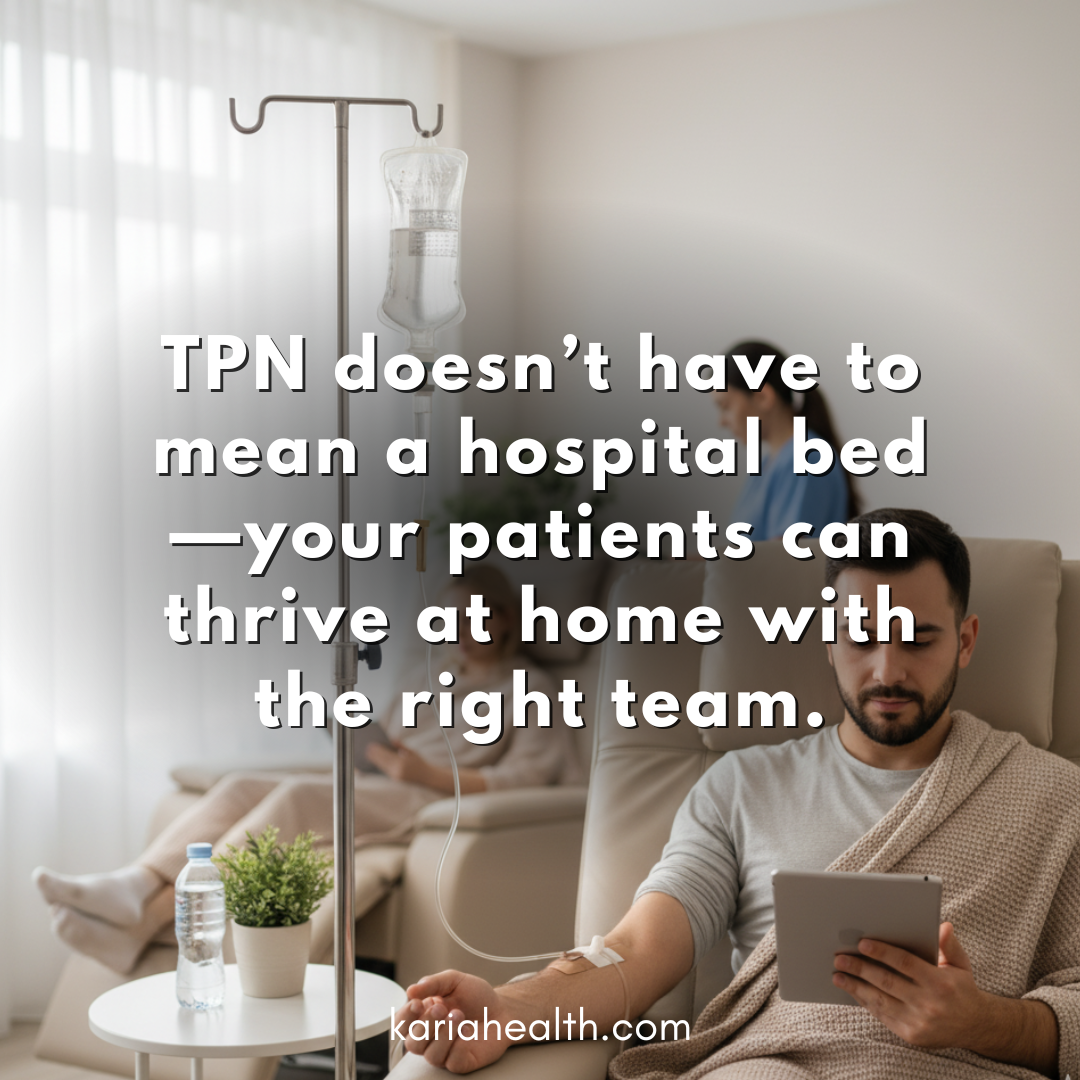
Patients who cannot meet their nutritional needs orally or enterally depend on Total
Parenteral Nutrition (TPN) as a lifeline. Delivering TPN in an outpatient or home
setting is both feasible and safe—but it requires a disciplined, coordinated approach
between the infusion center, the ordering provider, the compounding pharmacy, and,
often, a nutrition specialist.
At Kariah Healthcare LLC, we’ve built a comprehensive TPN support program that
allows gastroenterologists, oncologists, hospitalists, and dietitians to transition
appropriate patients out of the hospital sooner while ensuring meticulous oversight
throughout therapy.
Why Outpatient TPN Works
- Research confirms what frontline clinicians already observe:
- Starting TPN at home or in the ambulatory setting is as safe and effective as
initiating therapy in the hospital when proper monitoring is in place.
- Outpatient TPN can reduce inpatient days without compromising nutritional or
clinical outcomes.
- (Recent studies published on ResearchGate highlight equivalent safety profiles and
significant reductions in hospital utilization.)
- For stable patients—such as those with severe malabsorption, postoperative
complications, or advanced gastrointestinal disease—shifting TPN out of the hospital
supports better continuity of life and care.
How We Coordinate TPN Therapy
- 1. Collaborative Initiation
We start by working directly with the ordering physician to confirm:
The TPN indication and expected duration
Access type (PICC, tunneled catheter, or port)
Any disease-specific nutritional considerations
Baseline labs (electrolytes, liver function, triglycerides, CBC)
From there, we coordinate with the compounding pharmacy to prepare the
individualized TPN formula.
- 2. Patient & Caregiver Training
TPN is complex, but patients can succeed with the right preparation.
Our infusion nurses provide structured teaching that covers:
Aseptic technique for line access
Pump setup, programming, and troubleshooting
Safe connection and disconnection
How to recognize early signs of complications (infection, electrolyte changes,
catheter issues)
When needed, we coordinate home health nursing for additional reinforcement,
dressing changes, and line assessments between clinic visits.
- 3. Ongoing Clinical Monitoring
TPN management is a dynamic process, not a “set it and forget it” therapy. We support
providers by handling routine oversight, including:
Weekly or bi-weekly labs to track electrolytes, liver enzymes, triglycerides, and
hydration status
Daily symptom check-ins as needed
Adjusting TPN components (calories, macronutrients, micronutrients) in
collaboration with the ordering physician and dietitian
Central line maintenance to prevent infections and catheter occlusion
Every adjustment is communicated back to the provider, ensuring they maintain full
visibility into the patient’s nutritional status and progress.
- 4. Early Identification of Complications
TPN complications often show subtle early signals. Our team closely tracks:
Hyperglycemia or glucose fluctuations
Liver dysfunction
Fluid imbalance
Catheter-related issues
Refeeding symptoms in malnourished patients
When a concern arises, the referring provider is contacted immediately, and
interventions are coordinated to avoid deterioration or unnecessary readmission.
- A Typical Scenario: TPN Done Right
A patient with Crohn’s disease and severe malabsorption is discharged with a PICC line
and nightly TPN.
Here’s what our model looks like:
We complete the initial nurse teaching before discharge.
The patient begins nightly infusions at home with confidence.
Weekly labs are drawn to monitor electrolytes and liver function.
Our team adjusts the TPN formulation based on nutritionist recommendations.
The gastroenterologist receives regular updates and flags any needed changes.
The result:
Nutritional stability, fewer hospital days, and consistent oversight without
disruption to the patient’s life.
- Why Providers Trust Kariah Healthcare for TPN Management/li>
- Highly trained infusion nurses with strong competencies in central line care
- Evidence-based protocols aligned with ASPEN, CDC, and INS guidelines
- Continuous communication with referring clinicians
- Safe, controlled environment that lowers exposure to hospital-acquired
infections
- Proven ability to stabilize complex GI and oncology patients outside the
hospital
- Your patients receive uninterrupted nutritional support—and you stay fully informed as
their clinical status evolves.


 kariahhk
17 November 2025
kariahhk
17 November 2025


All Comments